
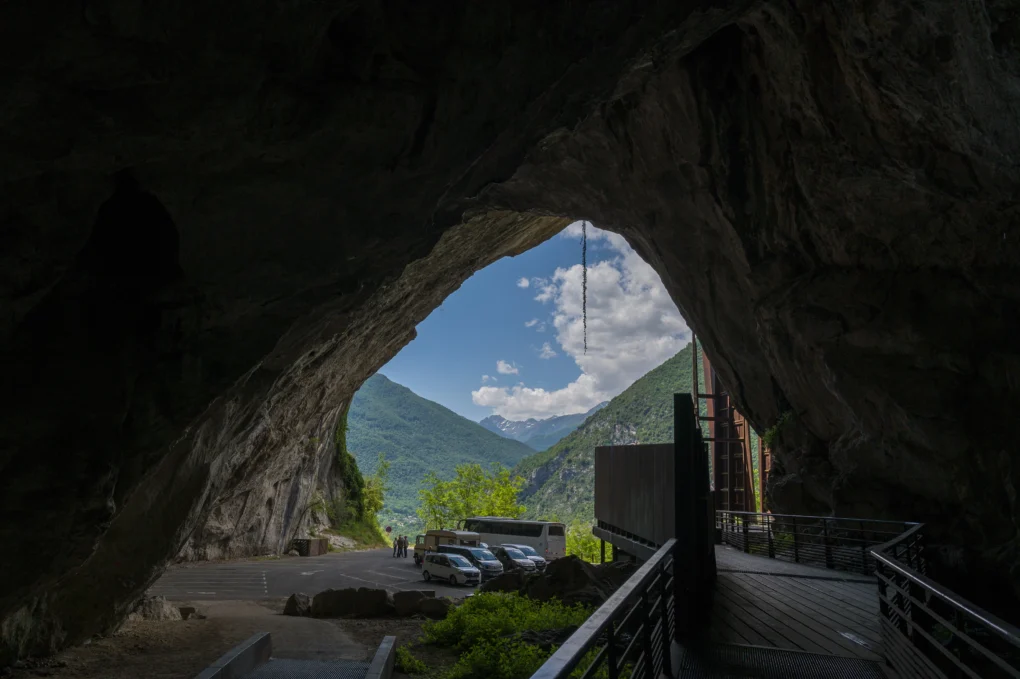
Less than 10 km from the Ariège Evasion campsite, the Niaux cave is a masterpiece of the Upper Paleolithic period. You can admire the genuine Magdalenian paintings, over 14,500 years old.
This major site is one of the few prehistoric sites still open to the public.
In the Dordogne, the Lascaux cave is closed; you can visit its replica. In Vallon-Pont-d'Arc in the Ardèche, the Caverne is a copy of the Chauvet cave. The Cosquer cave has a replica, but seeing the original cave is impossible.
In Niaux in Ariège you can have a complete immersive experience! The exploration takes place by the light of a lamp provided by the guide who will supervise you.
 What you will discover
 What you will discover
-
The Black Room: Located approximately 800 meters from the entrance, this gigantic natural rotunda serves as a prehistoric cathedral. The walls come alive under the beams of lamps to reveal more than 70 paintings of animals in black outline with exceptional anatomical precision (bison, horses, ibex and a magnificent stag).
-
The enigmatic signs: Throughout the journey, you will observe series of dots, geometric lines and claviforms drawn in red and black, whose mystical and spiritual meaning remains intact even today.
A demanding exploratory visit
 A demanding exploratory visit
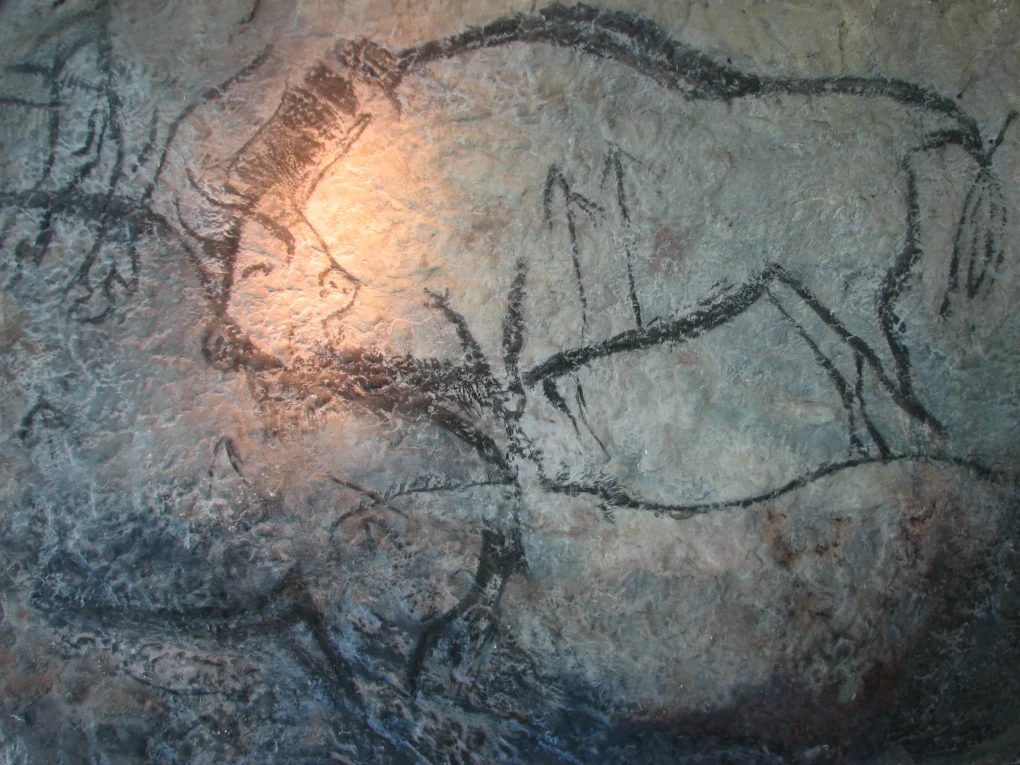
To preserve the artworks from climatic alterations and human respiration, the cave applies strict access rules and the visit resembles a true underground hike:
- The route: The visit lasts 1 hour 45 minutes for a 2.4 km round trip walk. The ground is natural, uneven, rough and sometimes slippery.
- Conditions & Equipment: The cave is neither developed nor lit. The internal temperature remains constant at 12°C year-round. Closed walking shoes and warm clothing are essential.
- Strict restrictions: Due to the terrain and site safety, strollers, baby carriers, bags (of any size), walking sticks, as well as photography and videography, are strictly prohibited. Animals are not allowed.
- Age & Accessibility: The visit is impossible for people with motor disabilities and strongly discouraged for children under 6 years old.
A bit of history
The Niaux cave was not "discovered" all at once, as its main entrance has always been known and frequented throughout the centuries. Its history can be summarized in several key stages:
-
Ancient knowledge and graffiti: The cave has been frequented for a very long time. Wall inscriptions (graffiti) left by visitors date back to the 17th century (such as that of Ruben de la Vialle in 1660). In the 19th century, it served as a tourist attraction for spa visitors to Ussat-les-Bains.
-
Visits by prehistorians (1866): The archaeologist Félix Garrigou visits the cave, but is unable to interpret or date the parietal paintings to that time.
-
The scientific rediscovery of the Salon Noir (1906): On September 21, 1906, Commander Molard and his sons explored the Rotunda room (the famous Salon Noir) and noticed the paintings of prehistoric animals. They immediately alerted Émile Cartailhac, professor of prehistoric archaeology at the University of Toulouse.
-
The authentication (1908): Émile Cartailhac and Abbé Henri Breuil studied and officially authenticated these major works of Magdalenian art, publishing their work in 1908.
-
Subsequent explorations: New parts of the cave were later discovered, notably the Cartailhac Gallery by Joseph Mandement in 1925. The Clastres Network was discovered in 1970 beyond underground lakes. This exploration was led by the SCHS (Haut Sabarthez Speleological Club), presided over by Jean Claude Marfaing. Does that name ring a bell? David, the campsite manager, is his son 😉
Isolated from the rest of the Niaux cave by permanently damp vaults, and accessible after the pumping of several underground lakes, it was first explored using free diving with flashlights placed in waterproof containers
-
Cave art: At the center of this network, 5 animals were drawn in black line (3 bison, 2 of which are incomplete, 1 horse and a weasel/mustelid).
-
The weasel: The representation of the weasel in this network is a unique and extremely rare work in prehistoric Paleolithic art.
-
Access: The network is closed to the public for conservation reasons, with the exception of a brief, exceptional opening during the summer of 2006.
Jean-Claude Marfaing and René Clastres are the key figures in the discovery of this secret gallery.
-
Jean-Claude Marfaing is the speleologist from Ariège who led the decisive expedition in 1970.Under his guidance, and with the team from the Haut-Sabarthez Speleological Club, they undertook the complex task of pumping the water from the third underground lake (the third siphon) that blocked access to the cave system. By overcoming this aquatic obstacle, his team opened the way to this unexplored network.
-
René Clastres was a passionate speleologist (and a member of the team). He was the curator of the cave. It is in his honor that the gallery was named the René Clastres Network.
The René Clastres network:
Thanks to the persistence of Jean-Claude Marfaing and the memory of René Clastres, this Paleolithic sanctuary was able to be revealed to science, yielding in particular the famous and extremely rare painting of the weasel.
Jean Clotte is an internationally renowned prehistorian who has scientifically studied, documented, and revealed the importance of the Clastres network and the Niaux cave. For this researcher, who has made Ariège his adopted home, Niaux has become his "second home.".
The scientific study of the Clastres Network by Jean Clottes.
Appointed Director of Prehistoric Antiquities for Midi-Pyrénées shortly after the network's discovery in 1970, Jean Clottes took charge of the study of this untouched gallery. He led the essential research sessions (notably in 1990 and 2006) to analyze this sanctuary, which had remained untouched for millennia.
-
The weasel analysis: It was under his expertise that the 46 cm black tracing representing the mustelid was officially identified as a unique piece of parietal art in the world.
-
The study of the footprints: He meticulously analyzed the tracks of fossilized footprints in the clay of the Clastres network, proving that they belonged to a group of prehistoric visitors, including three children (aged 8 to 10 years).
Immerse yourself in the heart of prehistory by exploring the Niaux cave, one of the largest and most moving Paleolithic sanctuaries in Europe still open to the public. Equipped with only a flashlight to preserve this fragile treasure, you will walk in the footsteps of the Magdalenians in the solemn darkness of the underground galleries, all the way to the breathtaking Black Salon. There, illuminated by the beams, authentic 14,000-year-old masterpieces will emerge from the cave wall: bison, horses, and ibex drawn in black lines with striking precision and realism. It's a rare immersive experience, a mystical and direct journey through time, far removed from replicas and artificial museums. Made in Ariège!
Reservation
 Reservation
Visitor numbers are extremely limited to protect the paintings (groups are restricted to a maximum of 25 people). is Online booking mandatory in advance (several weeks ahead for summer slots or tours in English or Spanish).