
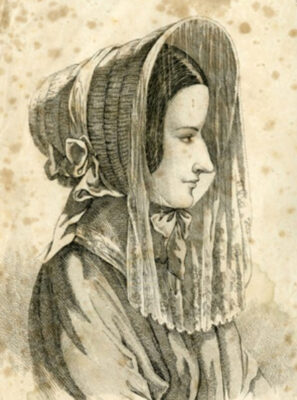
Marie Fortunée Capelle was born in Paris on January 15, 1816. She will be remembered in history for her married name, Marie Lafarge.
She died in Ornolac on September 7, 1852.
Marie Lafarge was suspected, then found guilty by the courts of the time, of poisoning her husband, Charles Pouch-Lafarge. The Lafarge affair, the trial of which was the subject of much commentary, gave rise to numerous books describing or analyzing the case, as well as films in cinema and on television.
Marie Lafarge was sentenced in 1840 to forced labor for life by the Tulle Assize Court and to public exposure in the town square.
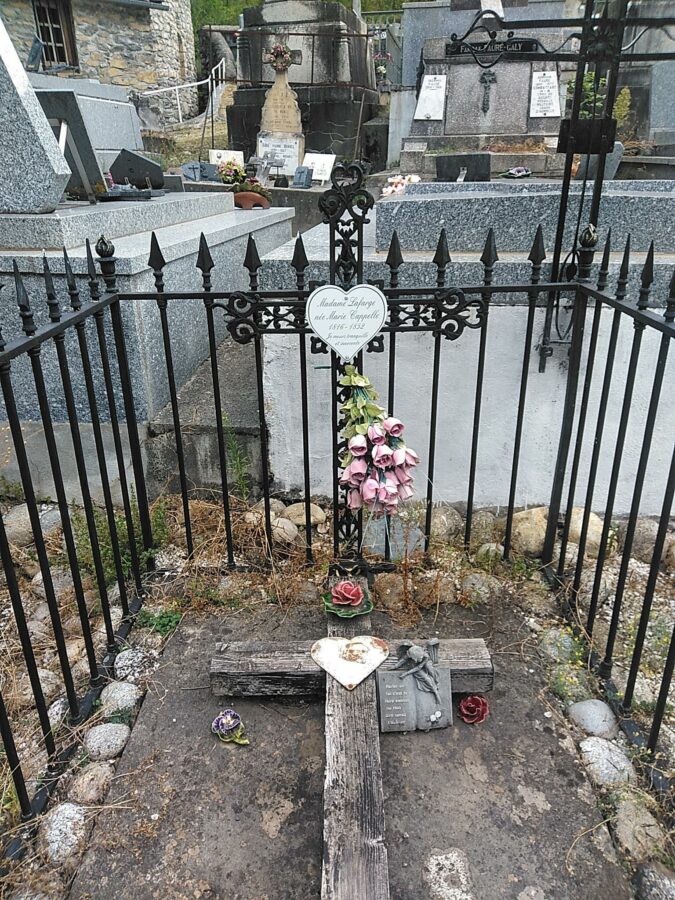
Marie Lafarge received a presidential pardon from Prince-President Louis-Napoleon Bonaparte shortly before her death in 1852. Her tomb is located in the cemetery of Ornolac-Ussat-les-Bains.
Origins and early life of Marie Lafarge
Marie Capelle was born into a good family and received an excellent education in the Aisne region.
Her maternal grandmother, Herminie Compton, was allegedly born from an affair between Countess Félicité de Genlis and Philippe Égalité, Duke of Orléans. This supposed lineage would have considerable influence during her trial, which took place during the July Monarchy and the reign of Louis-Philippe, Philippe Égalité's legitimate son. The press, which the government had muzzled with the September Laws of 1835, was quick to denounce this "Orleanist bastard turned poisoner," and this could have shaken the throne.
Marie's father, a former artillery colonel in the Imperial Guard and an officer of the Legion of Honour, died in a hunting accident on November 10, 1828. Marie was twelve years old… Her mother remarried and died seven years later…
Seeking romantic love, Marie declined all marriage proposals. She proposed to Count Charles Charpentier, son of General Henri François Marie Charpentier, who lived in a nearby castle in Oigny-en-Valois, but the Count didn't seem to take the idea very seriously. The Count refused the marriage…
According to the book *Les grandes affaires criminelles*, published by Éditions Courtille, Marie then met the young Denis Guyot, whose presence and elegance she admired, and with whom she maintained a purely epistolary relationship. The young bourgeois seemed in no hurry to marry. Marie's uncle, Baron Garat, Governor of the Bank of France, demanded that the relationship end. Marie complied and left her suitor the very next day. When he learned of the young woman's arrest and conviction, Denis Guyot took his own life
At twenty-three, with the help of her uncle, Baron Garat, who contacted a marriage agency, Marie Fortunée Capelle met Charles Lafarge, an entrepreneur from Corrèze, five years her senior. A forge master at Glandier, in the commune of Beyssac, he was also the mayor of the town. During their meeting, Charles and Marie provided assurances of their good character, and then, somewhat hastily, the marriage was celebrated on August 11, 1839, at the Notre-Dame-des-Victoires church.
From idyllic love to disappointment…
Overwhelmed by financial difficulties, Charles Lafarge knew that by marrying her, he would receive a dowry of 80,000 gold francs, which would allow him to avoid bankruptcy. Often described as a "good man, but a bit gruff," other accounts portray him as a vile and corrupt character, riddled with violence, and also prone to epileptic seizures…
Marie is in for a series of unpleasant surprises: her new husband's home is a dilapidated old hovel, infested with rats, and which some local farmers claim is haunted… Her husband lied to her. He made her believe he owned the Château de Pompadour in Arnac-Pompadour, which he didn't…
In despair, Marie Lafarge barricades herself in her room and writes a letter to her husband. Marie begs him to let her leave. She offers him her dowry in exchange. Marie even threatens to take her own life.
Her husband flatly refused. Marie's feelings toward her husband returned. But secretly, she began searching for money. She would use every means at her disposal, even making a will in her husband's favor. She even wrote him passionate love letters…
In return, her husband, touched by these gestures or perhaps calculating, made a will in her favor, bequeathing all his possessions to her. But immediately afterward, her husband made another will in favor of his mother and sister…
Marie wrote to the Eyssartier pharmacy in Uzerche to obtain rat poison, because according to her own statements her home was infested with rats.
It was one of the servants, Denis Barbier, a small-time Parisian crook whom Charles Lafarge had met in Paris, who was tasked with retrieving the product. Barbier was in fact a key figure in the affair, as he was the one who would put forward the theory of poisoning…
Marie also asked her cook to bake cakes to send to her husband. After a four-day journey by stagecoach, on December 18, 1839, the pastries, made with unpasteurized milk, arrived at their destination. That same day, Baron Lafarge fell seriously ill. Charles Lafarge suffered from frequent vomiting and migraines. He decided to cut short his stay in Paris and returned to Beyssac. He arrived at Le Glandier on January 3, 1840, and immediately summoned the family doctor, who diagnosed a simple case of tonsillitis. Marie took it upon herself to care for her husband.
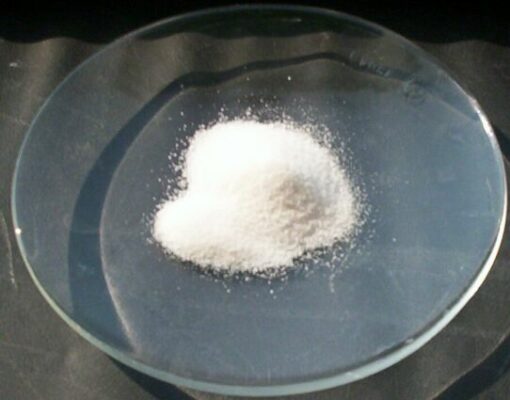
At the same time, she sends another letter to Mr. Eyssartier, the pharmacist in Uzerche, in order to obtain rat poison once again…
Charles's condition suddenly worsened, and the doctor summoned to his bedside was powerless. He died in excruciating pain eleven days after his return, on January 14, 1840, at 6:00 a.m
The deceased's mother has already spread the rumor that her daughter-in-law poisoned her son and immediately notifies the public prosecutor.
An investigation was opened. The day after his death, the gendarmerie searched the premises and discovered arsenic everywhere: on the furniture, the food, from the cellar to the attic. Of the fifteen toxicological analyses performed on Charles Lafarge's body, the doctors of the time found only one instance of "a minute trace of arsenic." On January 16, 1840, an autopsy was performed, but it revealed no abnormalities. Organs were nevertheless removed for later examination.
On the morning of January 23, 1840, Brigadier Magne and Gendarme Déon arrested Marie Capelle-Lafarge at her home in Glandier and took her to the Brive prison. On January 31, 1840, Jacques Antoine Desrote, police commissioner of Paris, searched Charles Lafarge's apartment in Paris for any possible traces of cakes. Nothing suspicious was found.
In early February, Count Léautaud accused Marie Lafarge of stealing a diamond parure belonging to the Countess. On February 10, the diamonds were discovered hidden in the wall of Marie's bedroom…
The trial begins… with a battle of experts:
After analyses carried out by chemists from Tulle and Limoges which detected no trace of arsenic, the public prosecutor is requesting a new autopsy of Charles Lafarge's body.
During the trial, the possibility of food poisoning was not raised. Charles Lafarge felt unwell after eating cream puffs sent by his wife, hence the accusation of poisoning. But he could just as easily have died from the unpasteurized cream and butter pastries that had traveled for three days…
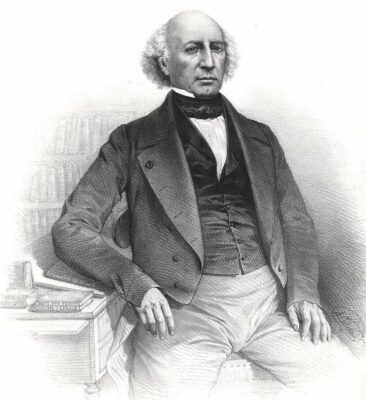
Mathieu Orfila, dean of the Paris Faculty of Medicine, inventor of forensic toxicology and one of the authors of the manual for the Marsh apparatus that detects traces of arsenic, a leading figure in science and a staunch royalist close to the Orleanist regime, was dispatched from Paris. To everyone's surprise, he detected, through manipulations now considered dubious, a minimal quantity of arsenic in the deceased's body. Immediately after giving his statement, he returned to Paris, taking with him the reagents used for the counter-analysis.
The presence of arsenic in Lafarge's body thus became the central thread of the trial. Maître Théodore Bac understood this well and took a desperate gamble: he asked Raspail, a brilliant chemist from Paris, to lend his expertise to the defense. Raspail took thirty-six hours to reach Tulle, but by the time he arrived, the jury had already deliberated four hours earlier. It was too late to prove a so-called "natural" presence of arsenic in all human bodies – human bones do, in fact, contain arsenic…
On September 19, 1840, Marie Lafarge was sentenced to forced labor for life and to one hour of public exposure in the Tulle town square…
The affair caused a considerable stir at the time. Marie Capelle-Lafarge's social background and her probable cousinship with King Louis-Philippe, her personality, and the enigma of the poisoning all contributed to this.
Criticism poured in from conservative and Catholic circles. Support came primarily from intellectuals and modernists, who saw this presumption of guilt as taking precedence over the inconsistency of the evidence, such as Alexandre Dumas and George Sand. The writer, in a letter to Eugène Delacroix, described it as "a case badly handled and sordidly prosecuted by the public prosecutor."
Detention and death:
Marie Lafarge was sent to the Toulon penal colony. The rapid deterioration of her health led Louis-Philippe to commute her sentence to life imprisonment.
Transferred to one of the towers of Montpellier prison, she contracted tuberculosis there. For this reason, the Minister of the Interior, Pierre Jules Baroche, agreed to her transfer to the sanatorium in Saint-Rémy-de-Provence.
Prince-President Louis-Napoleon Bonaparte pardoned her by decree and she was released in June 1852.
She died on September 7th of the same year in Ornolac-Ussat-les-Bains, our small spa town located in the Ariège department, where she had retired. Marie Lafarge is buried in the Ornolac-Ussat-les-Bains cemetery, a few hundred meters from the Ariège Evasion campsite.
Throughout her imprisonment, she wrote a diary published under the title "Hours in Prison", in which Alexandre Dumas saw "the beating of the prisoner's heart during those nine years".
Maître Lachaud, his lawyer during his trial, continued to maintain his tomb after his death and, when, thirty years later, he himself was overcome by illness, he asked Paul de Cassagnac's wife to continue to place flowers on the tomb:
"Those who believe in Marie Capelle's innocence are becoming increasingly rare. Since you are one of them, promise me you will tend her grave when I die… that thought will do me good."
Charles Lachaud
Aftermath of the case
A legal enigma
"Front plot," "miscarriage of justice," "perfect crime"—these are terms sometimes used to describe or comment on the "Lafarge affair," which remains, according to many specialists in criminal history, one of the greatest unsolved mysteries in French legal history. Like other cases that have not been fully resolved, it leaves many unanswered questions.
Many writers, journalists and lawyers are still interested in this suspicious death today.
An investigation conducted in 1978 demonstrated that Charles Lafarge actually died of typhoid fever, the bacillus of which was poorly identified at the time.
Genealogist Chantal Sobieniak, while researching a legal case in Brive in 2010, discovered in a bag of documents 52 documents relating to a trial held in 1818 involving the Lafarge family and more specifically Marie Capelle's mother-in-law, Adélaïde Pontier, which led to the publication of the book "Rebondissements dans l'affaire Lafarge" (Twists and Turns in the Lafarge Affair).
In 2011, more than 170 years after the trial and conviction of Marie Lafarge, members of the family wished to launch a procedure to review her trial.
Michel Gache, president of the association “Cercle Marie Capelle – Marie Lafarge”, and Edouard de Lamaze, lawyer and great-grandnephew of Marie Lafarge, declare that they have “gathered enough new elements to reopen the case.
The association, which submitted the file to the Ministry of Justice, reports that it has indeed been delivered to the Minister of Justice. The group is awaiting a response from the Ministry of Justice
A reenactment of the trial was organized at the Tulle court on October 2, 2023, in the presence of 250 people as part of "Law Night".